



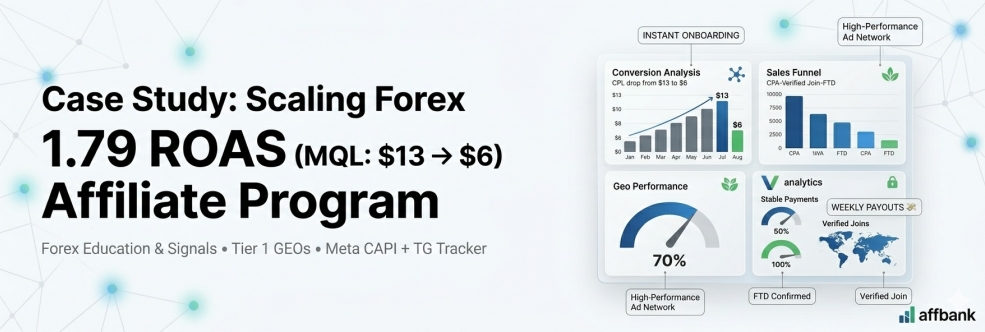
Case Study: Scaling a Forex Telegram Channel to 1.79 ROAS with Meta CAPI
- April 30, 2026
- by Affbank Team
- Reviews: 0
The Problem: A Forex affiliate was spending $500–$700/day optimizing for landing page button clicks. Reported “Leads” were inflated versus real Telegram joins, pushing Cost Per Subscriber (CPL) to $13.00 and keeping ROAS near break-even.
The Intervention: The conversion signal was moved server-side. A Lead event was sent only after a verified channel join, and a Purchase event was sent only after a confirmed broker deposit (FTD) via server-to-server confirmation.
The Result: The algorithm stopped optimizing for clickers and began optimizing for joiners and depositors. CPL dropped 58% to $6.00, and ROAS reached 1.79 within 14 days.
Sending Blind Traffic to Telegram
Telegram funnels in Forex/Crypto/iGaming break the default Meta playbook because the conversion happens inside a native app environment Meta cannot observe with client-side tracking.
The client was doing what most affiliates do:
● Optimize for a proxy event (landing page “Join” click)
● Assume the proxy represents a real join
● Scale based on click metrics
At $50/day, this is survivable. At $500–$700/day, it becomes a tax.
Client Offer Info
● Date: July 2025 (Pre Andromeda)
● Vertical: Forex education & signals
● GEO: Tier 1 (CA, AU, UK, UAE)
● Payout: $500 per FTD
● Spend: $500–$700/day
● Observed issue: CPL reached $13.00 and performance stalled
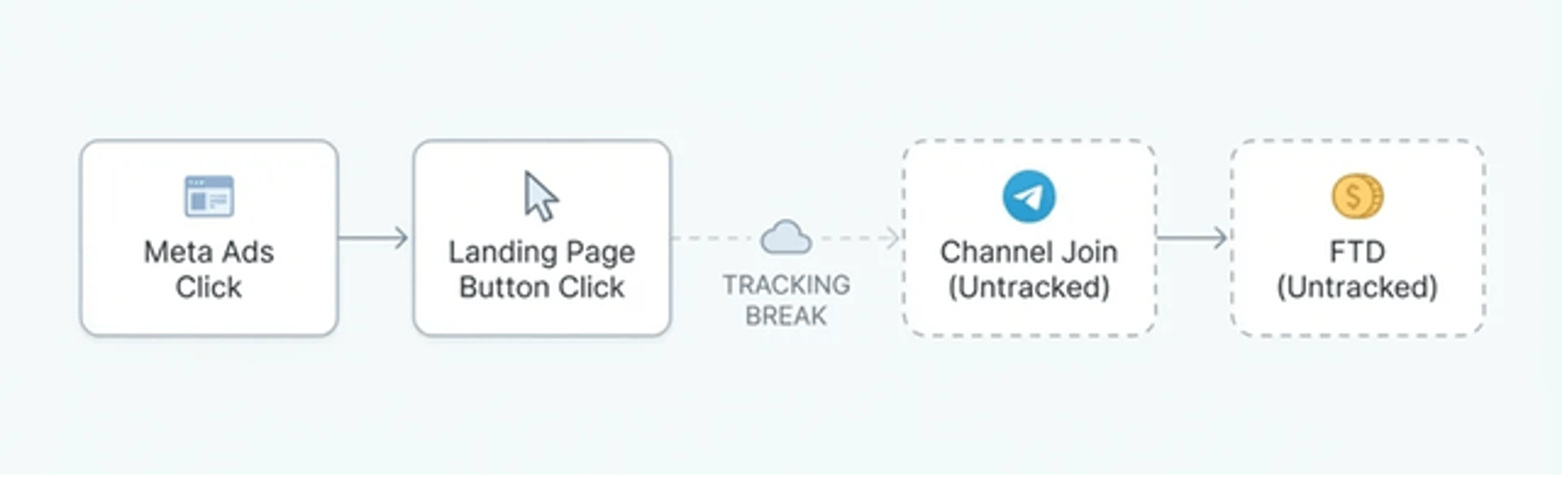
The underlying problem wasn’t creative, audience, or offer competitiveness. It was signal quality.
Note: This reduction is consistent with broader platform data, where Forex advertisers typically see a 20-45% drop in Real CPL when switching to server-side events, primarily due to the elimination of bot clicks from the optimization dataset.
Problem: Weak Optimization Signals
The account was rewarding the algorithm for the wrong behavior.
● Meta optimization signal: landing page button click (“Lead”)
● Business reality: confirmed Telegram join + eventual deposit
The gap was large enough to destroy economics:
● Meta counted “Leads” that never became subscribers
● The algorithm learned to find low-resistance click behavior
● Ad sets looked “efficient” in the dashboard while subscriber cost inflated
The practical consequence
The algorithm was selecting for users who:
● click readily,
● bounce at the Telegram handoff,
● and rarely convert downstream.
Without a tool like TG Tracker filtering these signals, the ad spend was essentially subsidizing low-quality traffic.
This is why the channel filled with “free-seekers” and low-intent traffic. The platform was doing exactly what it was trained to do.
Solution: Server-Side Conversion Signals
The fix was not a new landing page. It was an attribution architecture change.
Instead of letting the browser decide what a conversion is, the server decided based on verified outcomes:
1. Join confirmed → send Lead
2. Deposit confirmed → send Purchase
This approach accomplishes two things:
● removes proxy conversions from the dataset,
● and aligns optimization with revenue.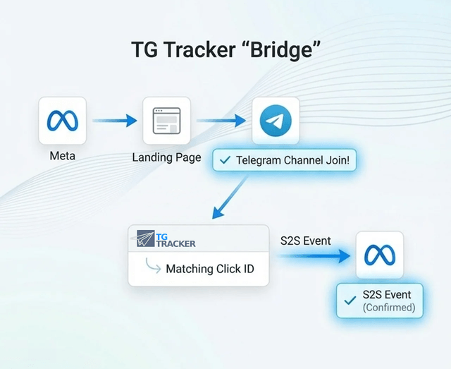
By using TG Tracker to manage the attribution flow, the client could implement this server-side logic without building custom backend systems.
What changed operationally
● Generic channel links were replaced with tracked entry links that preserve click identity through the Telegram handoff.
● A join was only counted when channel membership was confirmed.
● Deposits were only counted when the broker confirmed the event server-to-server.
The specific tooling is less important than the rules:
● No client-side proxy conversions
● Only verified events
● Full-funnel feedback back to the ad platform
Meta Ads Structure: 1–5–1 (Pre Andromeda Approach, be cautious)
The account was relaunched to let the verified signal retrain delivery from scratch.
Campaign structure
● Objective: Leads (optimized against the verified subscriber event)
● Layout: 1 Campaign → 5 Ad Sets → 1 Creative per Ad Set
● Budgeting: ~$100/day per ad set
● Targeting: Broad (no interests)
Broad was used intentionally. With verified events, broad targeting becomes a strength because the algorithm can explore efficiently when it’s fed clean truth.
Launch control
The relaunch started at the beginning of the account day to avoid uneven delivery. When campaigns are started mid-day, spending often compresses into a smaller window, which distorts early learning and increases volatility.
Results: Calibration Over 14 Days
Once Meta started receiving verified join signals, delivery shifted away from click behavior toward real Telegram entry.
Days 1–3: Learning volatility
● CPL still elevated due to new signal learning
● Day-to-day performance unstable
This phase is expected. The goal is not immediate efficiency; the goal is to establish signal integrity.
Day 7: Stabilization
● CPL: fell to $6.00 (down from $13.00)
● Click-to-Join rate: improved sharply because traffic quality changed
● Ad sets that looked good on clicks but poor on joins were naturally deprioritized
Day 14: Revenue alignment
● Deposit events began accumulating at a higher rate relative to spend
● ROAS: reached 1.79
● The campaign scaled without the usual quality collapse seen in click-optimized Telegram funnels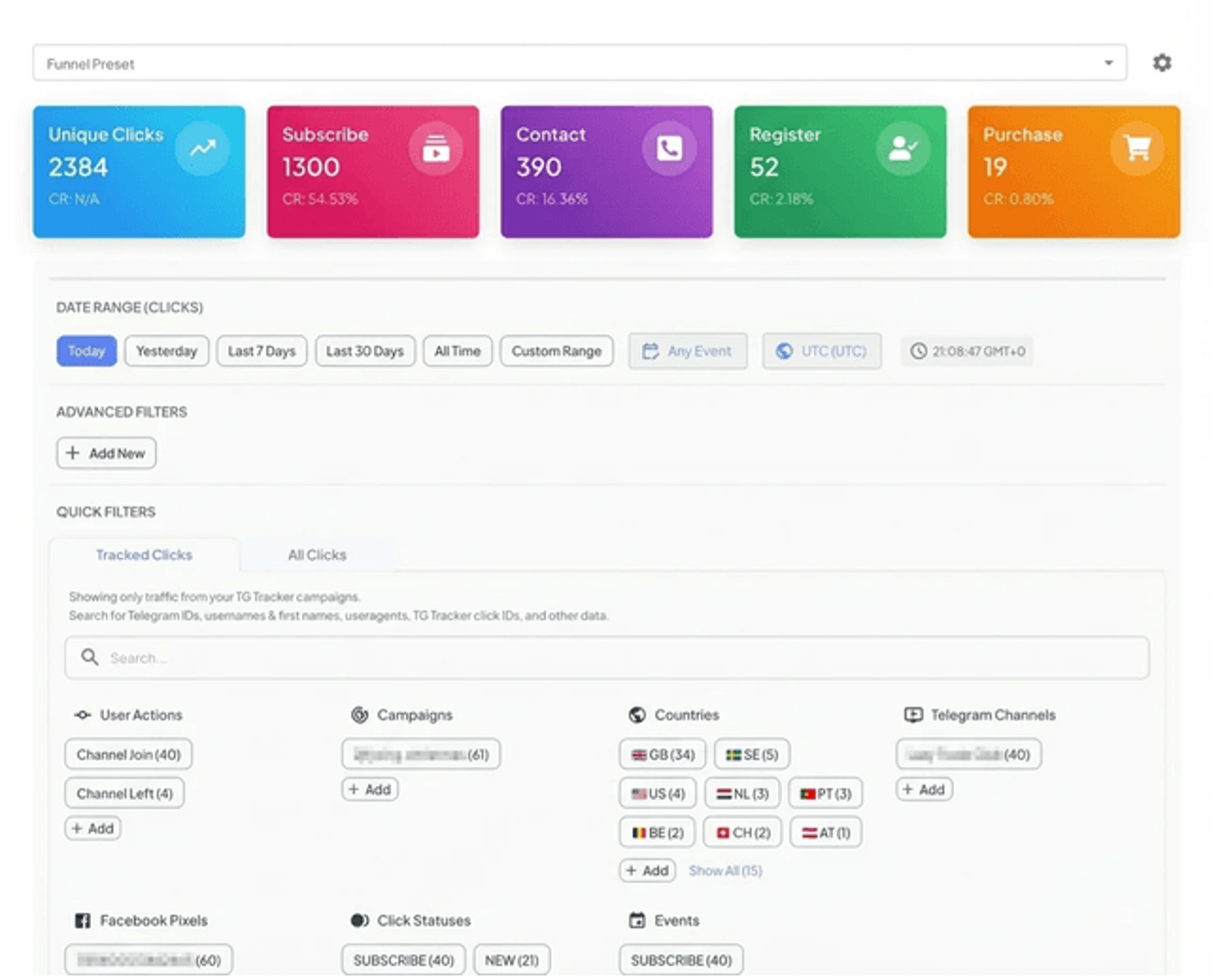
The key point: the system did not “get lucky.” It was trained on verified behavior.
Secondary Win: Creative Intelligence Based on Money
Before full-funnel attribution, the client evaluated creatives using CTR and click metrics. That is a common mistake in high-ticket verticals because the best buyers are not always the easiest clickers.
Once deposits were tracked back to ad sets/creatives, the ranking changed.
What the attribution revealed
● Creative A (Lifestyle): high CTR, low downstream value
● Creative B (Market/analysis): lower CTR, higher deposit concentration
Under click-based optimization, Creative B would typically be paused because it looks “expensive.” Under revenue-based attribution, it became the scaling unit.
This is one of the most practical benefits of server-side truth: it prevents you from scaling what only looks good on surface metrics.
Why This Worked
The outcome came from three structural corrections:
1. Verified joins removed proxy conversions
The algorithm stopped being rewarded for behavior that doesn’t create subscribers.
2. Deposit feedback tied optimization to money
The platform received a revenue-aligned outcome signal rather than an engagement proxy.
3. Cleaner datasets scale better
As budgets increase, click-optimized funnels degrade faster because the algorithm chases cheap interaction. Verified datasets hold a quality floor.
Strategic Takeaway
In Telegram-based high-ticket funnels, performance is primarily a data problem, not a creative problem.
If your Ads Manager “Leads” do not match your Telegram joins, you are paying for a proxy and training the algorithm on noise. The result is predictable:
● CPL inflates,
● ROAS stalls,
● scaling collapses.
When the platform is trained on verified joins and verified deposits, delivery aligns with business outcomes. You stop buying clicks and start buying conversion reality.
Recent Posts
October 06, 2026
Best Ad Spy Tools for Affiliate Marketing in 2026
Ad spy tools let you see what other affiliates are running, which creatives they use, and how long t...
Read moreSeptember 17, 2026
Webcam vs. AI Girlfriend: How Adult Offers Differ in 2026
Webcam has been one of the core verticals in adult affiliate marketing for years. Now, AI Girlfriend...
Read moreJuly 14, 2026
adset.pro Review: Tracker, PWA and Gaming Landers in One Stack for iGaming Buyers
In iGaming media buying, the biggest leak is often not the creative, not the offer, and not even the...
Read more
Written by
Affbank Team
Hey there! We combined years of experience, a ton of enthusiasm and our hunger for knowledge to give you the best that we can - Affbank. Leave a comment or reach us by email support@affbank.com